
5 Things Early Career EPs Should Know About Exercise and Cancer
Exercise has become increasingly accepted as an adjunct treatment for patients navigating cancer, with a surplus of evidence outlining the therapeutic benefits.
As an early-career Exercise Physiologist, sometimes when you hear the word ‘cancer’, it can feel really overwhelming to navigate. That’s okay! You’re not expected to know everything about the disease, but you play a really important part in supporting these patients through their treatments and beyond.
As a guide, here are some things that I wish I was told when I first started working in this space!
Having cancer doesn’t automatically mean ‘bedrest’
Diagnoses can be the same, but different
Treatments will influence your exercise prescription
Don’t be afraid of the word ‘metastases’
The person in front of you is more than their cancer diagnosis
Having cancer doesn’t automatically mean ‘bedrest’
Don’t get me wrong, rest is important. However, it’s also really important for cancer patients to move regularly. The Australian exercise oncology guidelines recommend up to 150 minutes/week of moderate intensity exercise, however for some patients this will fluctuate week to week.
Exercise is more powerful than you think, with regular structured exercise resulting in a 28% reduction in relative risk of cancer occurrence, new primary cancers, or cancer-related mortality (Courneya et al., 2025). Further, amount of muscle mass is one of the most important prognostic factors for someone with a cancer diagnosis, alongside having a higher VO2max, which further reduces risk of cancer-related morbidity and mortality.
This all sounds well and good from a theoretical standpoint, but sometimes, the person in front of you will be navigating extensive side effects of their treatments. Take chemotherapy, for example. It does a really good job at destroying the cancer cells (ie, what we want to get rid of), but also does a pretty good job at getting rid of all the good things in the body: muscle mass, bone mineral density, hormones and more.
So yes, whilst exercise is important, rest is equally as important for this population. Each patient will present differently, which I’ll continue onto below.
Diagnoses can be the same, but different
If two people have the same cancer diagnosis, it doesn’t mean they’re going to present the same. Let’s look at an example.
Patient #1 has breast cancer, and has had 2 lumpectomy surgeries, a lymph node biopsy, and radiation.
Patient #2 also has breast cancer, however they have had a bilateral mastectomy, chemotherapy and radiation.
Whilst both their diagnoses are ‘breast cancer’, you can see that their treatment pathways have been quite different. This can be due to a multitude of factors, based on stage of diagnosis, pathology and what is driving the cancer growth (sometimes it can be hormones, particularly in women’s health cancers).
This is where subjective questioning and screening is extremely important. Sometimes my subjective components of my assessments are more important than the initial objective measures. Take the time to listen to your patient’s diagnosis, what treatments they’ve had and any future treatments they may be undertaking. No two patients will present with the exact same concerns, even if they have the same diagnosis.
Treatments will influence your exercise prescription
This one kind of feeds into the above.
Take chemotherapy as a treatment option. Chemo is typically infused at regular timepoints. They can either be weekly, fortnightly or 3-weekly dependent on how aggressive the treatment is. Utilising something called ‘chemo periodisation’, we can adjust load, intensity and volume of prescription to suit when patients aren’t feeling great, versus when they’re feeling a bit better. You can have a plan for your patient’s session, but sometimes they walk into clinic, and your plan goes out the window. And that’s okay! Where we see sustainability in exercise habits is encouraging patients to listen to their body and what they are feeling, rather than pushing through for the sake of it.
Be prepared to prescribe exercise around symptoms and side effects. Some common side effects you may encounter:
Chemotherapy: fatigue, nausea/gastrointestinal symptoms, nerve pain or peripheral neuropathy, muscle mass reduction, bone mineral density reduction, brain fog, changes in appetite, to name a few.
Radiation: Fatigue is a big one(!!), if a patient has any burns or skin irritation, intensity needs to be reduced, to minimise sweating and subsequently minimise risk of further infection.
Moral of the story - be prepared to change your plans.
Don’t be afraid of the word ‘metastases’
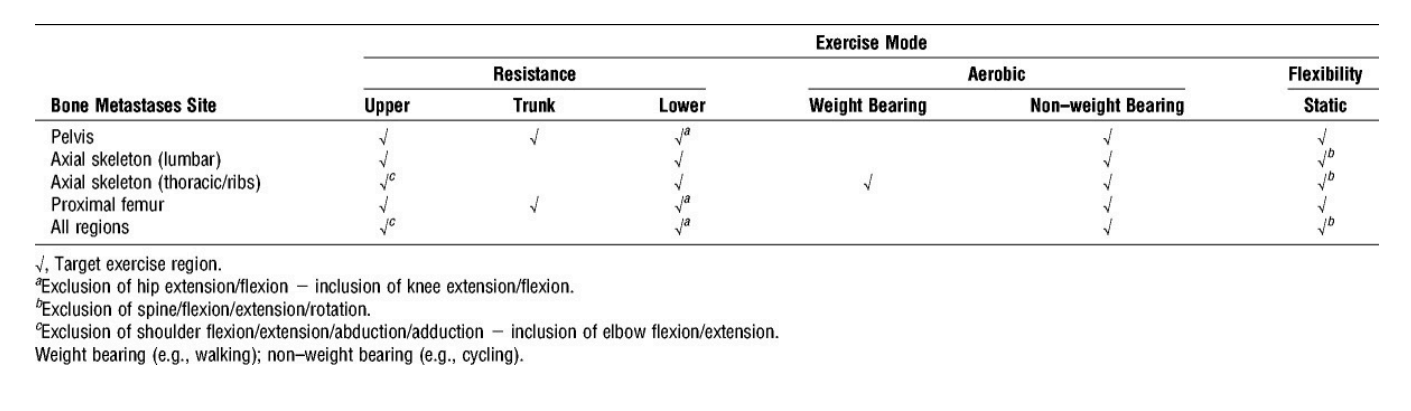
Metastases or metastatic lesions are where the primary cancer has spread to different parts of the body. These can either manifest as skeletal lesions, or soft tissue lesions. Sounds a bit scary, I know. A lot of patients and treating teams may hold concerns due to potential for fragility fracture. But, exercise has been proven to be safe for metastatic lesions. If in doubt, Galvao and colleagues (2017) provide a useful visual aid if you’re not sure how to approach exercise prescription:
The person in front of you is more than their cancer diagnosis
The most important one of them all. This rings true for any patient population you see, but I particularly emphasise this for cancer patients. These incredible people spend so much time in clinical hospital settings, doctors’ offices, scans, hooked up to IV, and all the things. The last thing they need is another clinical environment. Of course, there are lots of clinical considerations for this patient population. But remember that they are a person too, trying to find themselves, or an aspect of normalcy as they navigate their diagnosis.
Overall,
Exercise has lots of physical and physiological benefits to someone with cancer, but most importantly, exercise allows patients to find joy in movement, have some more social interaction, and build confidence in themselves again. That, I think, enables us as EPs to play a pretty powerful role in this population.
References
Courneya, K. S., Vardy, J. L., O'Callaghan, C. J., Gill, S., Friedenreich, C. M., Wong, R. K.
S., Dhillon, H. M., Coyle, V., Chua, N. S., Jonker, D. J., Beale, P. J., Haider, K., Tang, P. A., Bonaventura, T., Wong, R., Lim, H. J., Burge, M. E., Hubay, S., Sanatani, M., Campbell, K. L., … CHALLENGE Investigators (2025). Structured Exercise after Adjuvant Chemotherapy for Colon Cancer. The New England journal of medicine, 393(1), 13–25. https://doi.org/10.1056/NEJMoa2502760
Galvão, D. A., Taaffe, D. R., Spry, N., Cormie, P., Joseph, D., Chambers, S. K., Chee, R.,
Peddle-McIntyre, C. J., Hart, N. H., Baumann, F. T., Denham, J., Baker, M., & Newton, R. U. (2018). Exercise Preserves Physical Function in Prostate Cancer Patients with Bone Metastases. Medicine and science in sports and exercise, 50(3), 393–399. https://doi.org/10.1249/MSS.0000000000001454